



By Han Xin, People’s Daily
Five-year plans stand as a distinctive strength of China’s governance system.
31 provincial-level regions across the Chinese mainland have recently released their outlines of the 15th Five-Year Plan period (2026-2030). These development blueprints not only translate the country’s top-level design into concrete actions, but also reflect each region’s own exploration of development paths suited to its circumstances.
Viewed from multiple angles, these local plans offer a deeper understanding of the internal logic underpinning China’s economic growth and resilience.
One striking feature is the systematic approach to balancing the whole and its parts. A comparison of the plans across regions shows that, despite their different geographic conditions and resource endowments, all provinces have identified their strategic roles and development directions within the framework of the country’s overall development strategy.
Take target setting as an example. In line with the national goal of achieving both qualitative improvements and reasonable quantitative growth in economy, the vast majority of provincial-level regions have announced average annual GDP growth targets for the 15th Five-Year Plan period. Building on this, some of them have also introduced additional indicators tailored to local conditions, such as coordinated urban-rural and regional development and industrial transformation.
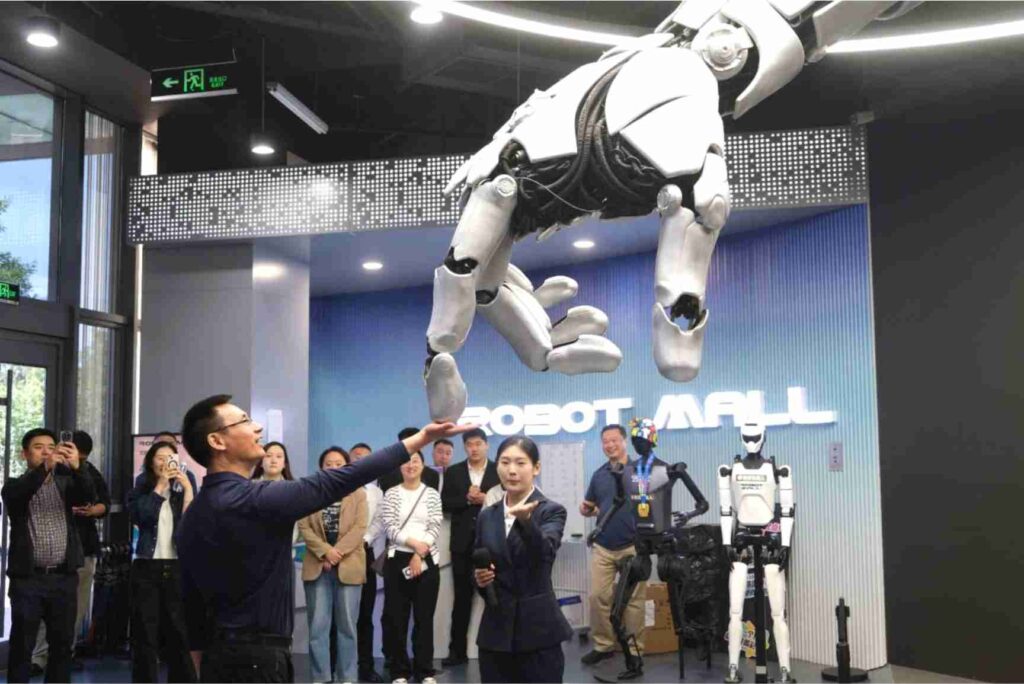
A man interacts with a giant robotic hand at a robot exhibition center in Beijing. (Photo/Guo Junfeng)
Likewise, while the national plan places building a modern industrial system at the top of its major strategic priorities, all 31 provincial plans have formulated targeted measures and differentiated tasks based on their own strengths and circumstances.
This model delivers full alignment across all government levels with a unified policy rhythm, while enabling each region to leverage its strengths and fulfill its respective responsibilities. It is precisely this synergy that fuels China’s sustained economic momentum.
Another notable feature is a reasonable balance between competing for opportunities and pursuing differentiated development. A cross-provincial comparison reveals both an eagerness to seize emerging opportunities and a pragmatic determination to capitalize on local advantages while avoiding disadvantages. Across the country, regions are making clear-eyed assessments of their strengths and weaknesses and pursuing development selectively and strategically.
As a strategic technology shaping the future, artificial intelligence (AI) has become a new frontier of industrial competition. Faced with this vast blue ocean of opportunity, regions across China are actively positioning themselves while emphasizing complementary strengths.
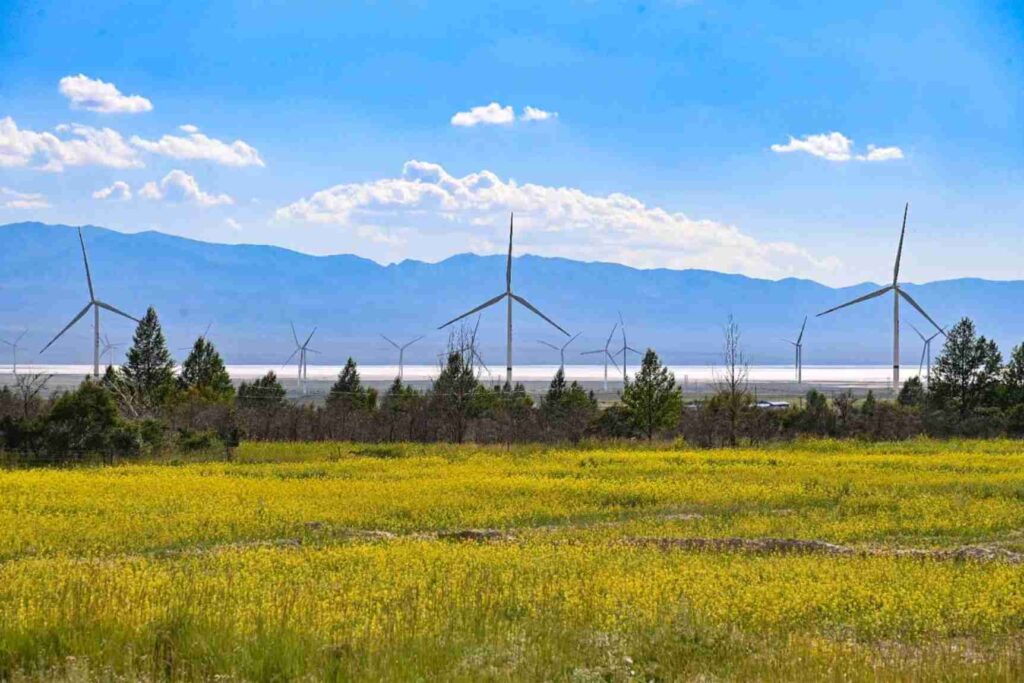
Photo shows a wind farm in Wulan county, northwest China’s Qinghai province. (Photo/Sun Kaifang)
The eastern region, leveraging its first-mover advantages, is climbing toward the technological frontier. Beijing strives to boost its capacity for original innovation powered by AI. Zhejiang province aims to hit 1.2 trillion yuan ($176.75 billion) in annual revenue from core AI industrial enterprises above designated size by 2030.
Meanwhile, the central and western regions are tapping into their resource advantages and exploring new depths. Guizhou province focuses on computing infrastructure, accelerating the development of the Guizhou hub center for the national integrated computing power network. Qinghai province capitalizes on its abundant wind and solar resources, aiming to build a demonstration zone for coordinated development of green power and computing capacity.
This combination of healthy competition and differentiated, complementary development has become a vital source of China’s drive toward higher-quality growth and innovation.
A third characteristic is the coordinated approach to fostering the new while upgrading the old. Looking across planning documents from different periods, from the 14th Five-Year Plan to the 15th Five-Year Plan, one finds a consistent problem-oriented approach and continuity in development thinking.
To foster and expand new growth drivers, Guizhou has adopted a pragmatic path in nurturing emerging industries. Rather than rushing to phase out traditional sectors, the province draws on its regional strengths to build a solid big data industry first — ranging from developing “China’s data valley” to rolling out a “data elements multiplier effect” initiative. It then applies digital technologies to empower the real economy, enabling a more seamless transition for traditional industries.
Shanxi province’s efforts to advance the energy transition provide another example. While harnessing its wind and solar resources and vigorously developing clean energy, the province is also committed to making better use of its coal resources. The two energy tracks complement and reinforce one another, achieving coordinated development.
China’s approach to economic development is therefore characterized by adapting measures to local conditions, combining scientific foresight and bold experimentation with steady, incremental progress.
By promoting the new while upgrading the old, and by ensuring that the new is established before the old is phased out, China has built the resilience that underpins its long-term economic stability and sustained growth.