


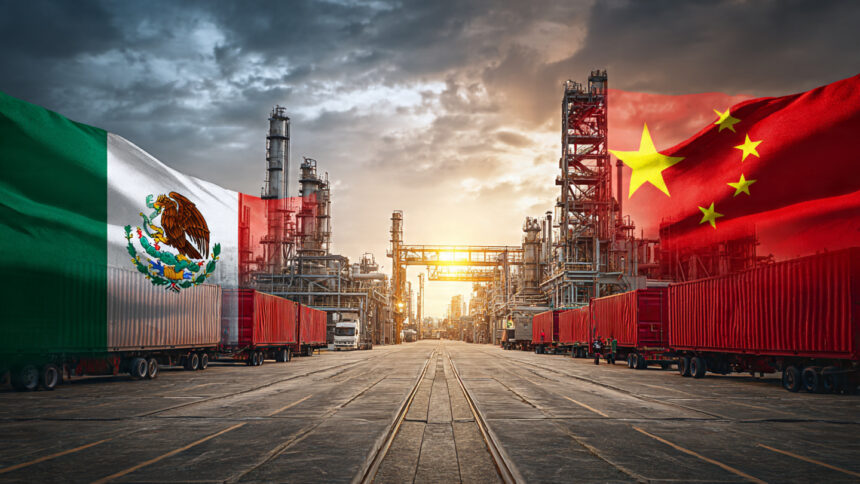
Mexico’s diplomacy with China in 2026 is shifting from “cheap imports” to “selective partnership.” With Olinia, Veracruz, and Laredo all in play, Mexico City is using economic diplomacy to protect its industrial base while keeping access to Chinese tech and capital.
Here’s how the 3 projects signal Mexico’s China strategy:
1. Olinia: A Counterweight in the EV Race
President Sheinbaum launched Olinia on June 7 as Mexico’s first domestically designed EV. That’s diplomacy by design. For 30 years Mexico and China built ∼1.1M cars annually. Today China makes 34.5M vehicles/year by controlling steel, minerals, and IP. Olinia, engineered by IPN, TecNM + 80 researchers in Puebla for MX$150,000, is Mexico telling Beijing: “We’ll buy batteries, but we design the car.” The goal is to avoid becoming just an assembly node for Chinese EVs entering the US market under USMCA rules.
3. Veracruz: Securing Inputs China Controls
The MX$190B Veracruz plan targets petrochemicals and fertilizers – two sectors where China dominates global supply. PEMEX’s MX$93B recovery for ethylene, aromatics, ammonia, and urea in Coatzacoalcos/Cangrejera aims to lift output to 849,000t petrochemicals + 4M tons fertilizer by 2030. Diplomatic logic: If Mexico produces its own industrial inputs, it negotiates with China from strength, not dependence. The Coatzacoalcos hub, tied to the Interoceanic Corridor, is pitched as an alternative supply route for Latin America.
3. Laredo Summit: Diversifying Beyond China Chains
The July 12-14 Global Trade Summit in Laredo highlights another diplomatic angle. As US-Mexico freight hit US$872.8B in 2025, Mexican officials used the forum to push nearshoring + “China+1” strategies. The pitch to global firms: build in Mexico for North America, source critical inputs locally in Veracruz, and use Laredo’s US$353.9B port to bypass trans-Pacific bottlenecks. The expanding World Trade Bridge is infrastructure diplomacy aimed at making Mexico more attractive than a China-Mexico-US triangle.
Mexico’s China Diplomacy Balance
Mexico isn’t decoupling from China. It still needs Chinese battery tech, machinery, and investment. But the tone has changed. Instead of just opening doors, Mexico is now setting terms: technology transfer, joint R&D in Puebla, and priority access to Mexican energy/ports in exchange for investment.
President Sheinbaum’s framing of Olinia as “the seed of a national industry built from Mexico” captures it. Diplomacy now means building capacity first, then negotiating deals.
With China, Mexico is moving from buyer to partner. Veracruz supplies inputs, Olinia builds IP, and Laredo moves the goods. The aim: stay integrated with China’s supply chain, but not dependent on it.