



By Su Bin, People’s Daily
On the evening of Aug. 22, the second Village Super League national tournament, an amateur football tournament in southwest China’s Guizhou province came to a close after several rounds of competition. In the final, the Jinli Chengjun Football Team from Gaoyao district, Zhaoqing, Guangdong province, defeated the Pumi Team from Wuhua county, Guangdong, in a penalty shootout to successfully defend its title.
Originating in Rongjiang, Guizhou province, the Village Super League has evolved from a local county-level event into a nationwide grassroots sports phenomenon. How did this transformation happen? And now that it has taken center stage, how can it sustain its appeal and continue to create value? People’s Daily looked into these questions.
“We played against football teams from all over the country. We made friends through the sport and gave our all on the pitch, showcasing the pure spirit of grassroots football.” The Jinli Chengjun Football Team wrote in a letter to the Village Super League the day after the tournament concluded.
For the first national tournament, teams were selected on a provincial level, with 51 teams eventually participating. The second tournament expanded its reach by setting up competition zones directly in counties and county-level cities across the country. A total of 102 county-level competition zones were established, each organizing its own preliminary competition to select a representative team. In the end, 105 teams competed in the national tournament.
“Selecting teams at the county level gives more ordinary people a chance to compete. It also creates opportunities for grassroots players and local cultures to take the stage at the Village Super League,” said Wang Yongjie, who oversees publicity for the event.
The larger number of participating teams has also raised the bar for event organization. How could the expanded field be managed effectively?
This year’s tournament introduced an innovative dual-track format combining a cup competition with friendly matches. 48 teams competed in the cup competition, progressing through group and knockout stages to vie for the national title. Another 57 teams took part in friendly matches, with the focus on cross-regional cultural and sports exchanges, intangible cultural heritage showcases and county-level tourism promotion.
The team from Xinhe county in northwest China’s Xinjiang Uygur autonomous region is made up of local fruit growers, teachers, and company employees. Making its national tournament debut this year, the team advanced through the county-level qualifiers to earn a place on the pitch in Rongjiang.
“For us, the biggest takeaway was the chance to compete and connect with football fans from across the country,” said team leader Kadia.
The tournament has also become a platform for promoting local products.
“Nujiang coffee came with our team to the Village Super League this time. The nationwide exposure provided by the tournament has further raised the profile of Nujiang coffee and delivered tangible benefits to related local industries,” said a letter of thanks from the publicity department of Lushui, Nujiang Lisu autonomous prefecture, southwest China’s Yunnan province, as the national tournament neared its conclusion.
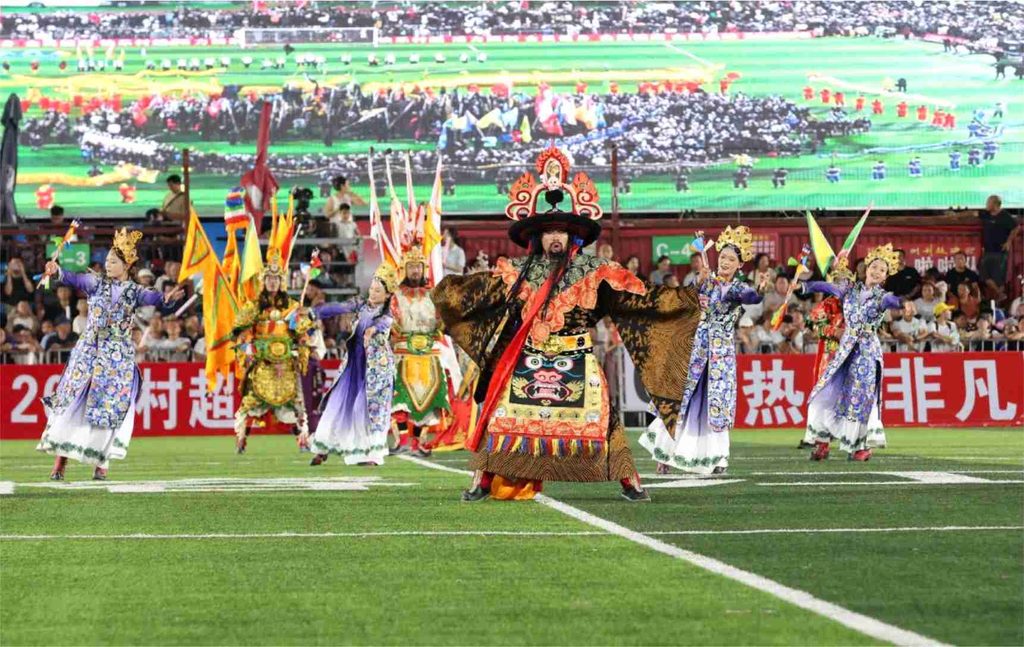
A performance troupe from Xizang autonomous region takes the stage at the opening ceremony of the final of the second Village Super League national tournament in southwest China’s Guizhou province, Aug. 8. (Photo/Yang Wenshu)
The letter noted that the Village Super League had grown beyond a sporting event to become a platform supporting comprehensive rural revitalization in remote areas.
One breakthrough of this year’s national tournament lies in setting up a county-level industrial development alliance for the Village Super League. Driven by the sports event and underpinned by industrial support, the alliance has delivered tangible cooperation across multiple fronts off the pitch, spanning culture and tourism, economy and trade, and agricultural products.
A harvest market was set up at the final, featuring specialty products from dozens of counties, including walnuts from Xinhe county, coffee from Nujiang, pears from Jinzhou in Hebei province and rice from Jixian county in Heilongjiang province. Many counties used the tournament as a platform to connect producers with buyers, helping local specialties ride the Village Super League wave to markets across the country.
During the preliminary competitions organized independently by participating counties, the alliance also provided free services and guidance, encouraging localities to build upon the Village Super League brand and develop tailored programs that would bring tangible benefits to their communities.
Some counties, for example, promoted each other as tourist destinations and jointly designed travel routes combining football matches, intangible cultural heritage experiences, and rural tours. During its qualifying competition, Xiaoyi, Shanxi province in north China, received more than 2.1 million tourist visits, directly driving increases of more than 35 percent in both catering and accommodation consumption.
How can the Village Super League experience be replicated elsewhere? How can the model be adapted to local conditions?
Local organizers have developed a range of approaches. In terms of coordination, Rongjiang has established a three-tier service system consisting of follow-up visits to competition zones, on-site guidance, and training programs in Rongjiang. For event services, it has shared its volunteer recruitment system and security system featuring identity verification and facial recognition at separate entrances, while establishing service standards covering medical care, transportation, accommodation, catering, and sanitation.
Can the Village Super League retain its appeal beyond Rongjiang?
“Whenever the model is introduced elsewhere, it has to be adapted to local characteristics. We hope to help more counties organize successful events in ways that suit their own conditions,” Wang said.
In the Jixian competition zone in Heilongjiang, local intangible cultural heritage has been incorporated into the tournament, bringing football together with local culture. The Chuxiong competition zone in Yunnan has used the event to promote its flower industry. Yiyang in east China’s Jiangxi province has linked the tournament with local opera traditions.
“This cooperative approach preserves the grassroots character of the Village Super League while unleashing the creativity of different localities,” said Han Wenbo, an official with the education and sports bureau of Fuping county, Baoding, Hebei province.
During the qualifying competition in Fuping, related content generated more than 447 million online views and directly drove 80 million yuan ($11.89 million) in consumption, turning the event into a new engine for integrating culture and tourism and promoting rural development.
By using sports to boost county-level development and competitions to benefit local communities, the Village Super League is becoming a shared development story, with localities across China joining hands to write new chapters.